
Understand metrics and retention
Choose a metric that matches your product question. Counting actions, people, and visits produces different answers even when you select the same event.
Product metrics
Section titled “Product metrics”| Metric | What it counts or calculates |
|---|---|
| Unique users | Distinct recorded identities with qualifying activity during the period. |
| Conversion rate | People in the denominator who also perform the numerator event, divided by people with meaningful activity or the explicit denominator event. This is not an ordered funnel. |
| Stickiness | Daily active users divided by active users in a trailing 30-day period. |
| Session count | Distinct visits with qualifying activity. |
| Session conversion rate | Sessions with the numerator event divided by meaningful sessions, or denominator-event sessions. |
| Observed session duration | Average time between the first and last recorded events in qualifying sessions. It is not a measurement of continuous attention. |
| Event occurrence count | Number of recorded custom-event occurrences. |
| Occurrences per unique user / per session | Custom-event count divided by the people or sessions containing those events. |
For example, five exports by one person can mean 5 occurrences, 1 unique user, and several or one session. Counts depend on what your app actually sends.
Retention
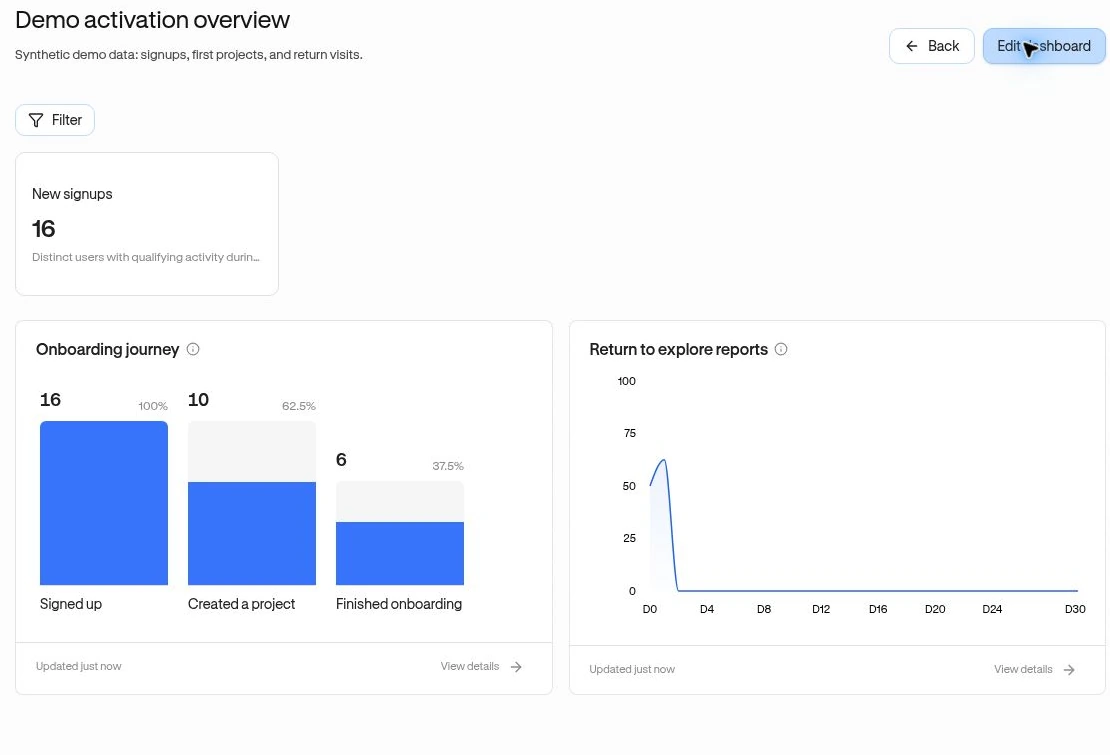
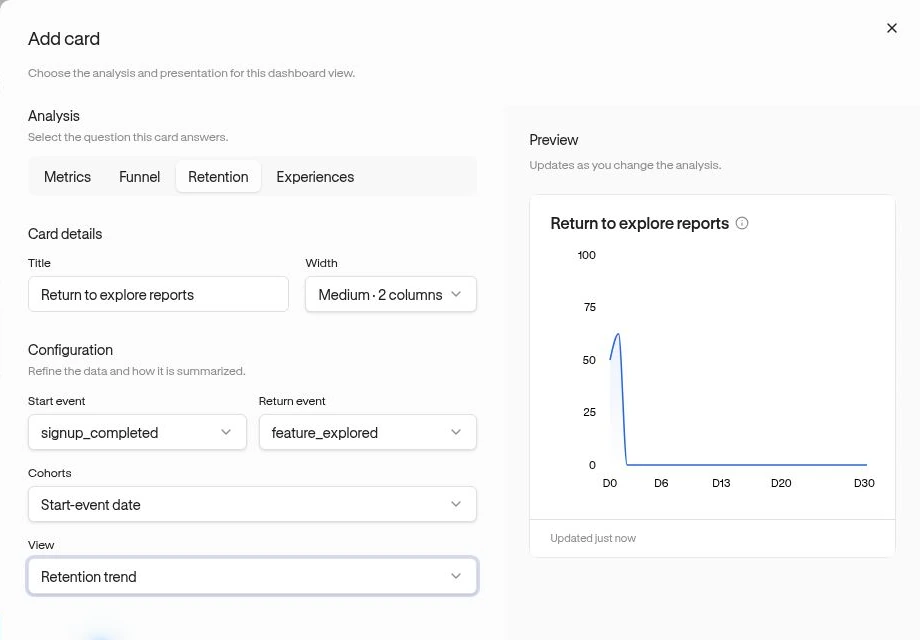
Section titled “Retention”A retention card groups people by their first matching Start event in the selected period and checks for the Return event in later time buckets. You can choose a specific custom event or Any meaningful event.
- Cohorts → Start-event date groups people by when they started.
- Current Segment comparisons uses membership now, not membership at the time of the original event.
- Cohort grid shows bucket-by-bucket results; Retention trend compares the return pattern.
- Daily, weekly, or monthly granularity changes the bucket size. Analytics buckets use UTC. The starting bucket (D0/W0/M0) can include the initial action when it also matches the return-event choice.
- Incomplete periods have not had enough observation time. Small cohorts can change sharply after a few visits.
Example: start with project_created and return with report_exported. This measures observed later use, rather than assuming any subsequent page visit represents value.
Identity and comparisons
Section titled “Identity and comparisons”Anonymous browser identities and identified accounts are not interchangeable. Historical activity keeps the identity recorded with it; do not assume all pre-login activity is reassigned to an account. See Users.
Use the same filters and time buckets when comparing periods. A dashboard comparison is evidence of a difference, not proof of its cause.
Related: Configure cards · Funnels.